ArbNet Arboretum Accreditation Program
The world’s only international accreditation program specific to arboreta.
ArbNet’s Arboretum Accreditation Program establishes and shares a widely recognized set of industry standards to empower and unify the arboretum community around the world.
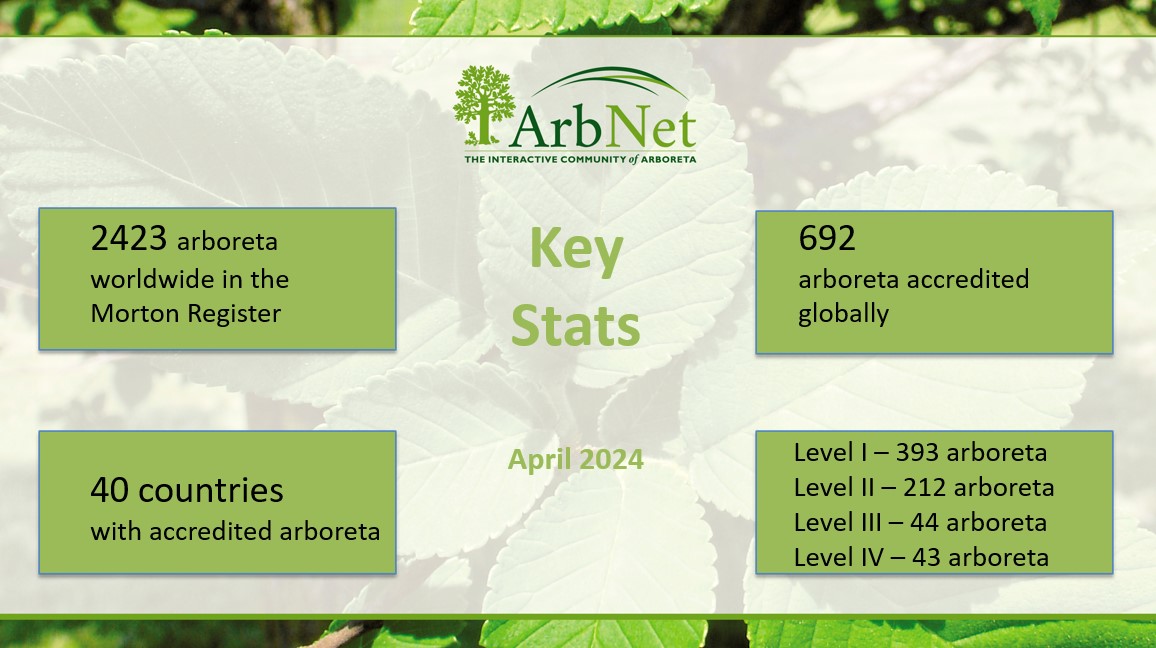
Accreditation at one of four levels is based on an arboretum’s self-assessment and documentation of its level of achievement of specific standards. The standards address planning, governance, the number of different taxa (species, subspecies, cultivars, varieties, etc.) of trees and woody plants in the collection, staff or volunteer support, education and public programming, and, for some levels, tree science and conservation efforts. Accreditation is free and is valid for five years.

Four Levels of Accreditation
ArbNet’s four levels of accreditation are designed to ensure that institutions of all types and sizes can be acknowledged for their achievements and supported in their growth—from school campuses and city parks to historic estates and large public gardens with substantial research and conservation programs.
Every institution can find an appropriate level of accreditation.
Each level builds on the next, offering a clear path for arboreta that have the capacity to develop further for greater impact.

Be Recognized for the Work
You Do for Trees
ArbNet’s Arboretum Accreditation Program is designed to meet each arboretum where it is, whether it is just beginning to care for a modest collection of trees or contributing to global research and conservation efforts. Around the world, arboreta of all kinds have successfully met accreditation standards. Your arboretum can become accredited too!

Accreditation Resources
Find information in these webpages to help your institution prepare to apply for ArbNet accreditation.
How to Apply
Read through the online application to ensure your arboretum meets the accreditation requirements.
Accreditation Resources
Explore resources and information related to the ArbNet arboretum accreditation application and process.
Arboretum Tool Kits
Find specific advice for cities, schools, universities, or cemeteries applying for arboretum accreditation.

Explore and connect with the world’s arboreta through the Morton Register of Arboreta

Subscribe to ArbNet’s Newsletter
Sign up for the quarterly ArbNet newsletter, which presents information on emerging trends and opportunities, shares success stories from accredited institutions, and offers valuable insights and resources from the broader tree care and conservation community.
Frequently Asked Questions
Get answers to some of the most common questions about ArbNet’s Arboretum Accreditation Program.
Contact ArbNet for more information.
What is an arboretum?
An arboretum is a living museum of trees and woody plants, grown and cared for by an organization committed to their stewardship. Arboreta serve not only as beautiful places to explore and enjoy, but can also provide vital community resources for personal wellness, environmental education, ecological conservation, and scientific research.
To learn more, visit What Is an Arboretum?.
Is there a charge for the application?
No. Application and accreditation are completely free.
Is our institution accredited if it is on the Morton Register of Arboreta?
No. The Morton Register is a separate listing of arboreta around the world, regardless of accreditation status. However, all accredited arboreta are also on the Morton Register.
Does our institution need to be on the Morton Register of Arboreta to apply for accreditation?
No. Any institution can apply for accreditation. As part of the accreditation process, your institution will be added to the Morton Register.
Can I tell from the Morton Register which arboreta are accredited?
Yes, accredited arboreta are noted along with their level in the Morton Register.
Is an in-person site visit required for accreditation?
No, not at this time. Accreditation is based on self-assessment.
Do all of our trees have to be labeled with their species to become accredited?
No. For each level of accreditation, a minimum number of tree species needs to be labeled. Although arboreta are encouraged to label as many trees as possible, accreditation only requires the stated number to be labeled.
What types of organizations can become accredited?
Many different types of organizations can become accredited arboreta. The list below provides some common examples, but is not exhaustive.
- Historical site
- Nonprofit
- Museum
- Cemetery
- University/college
- Business
- Town/city
- Zoo
- Golf Course
- Community/organization/neighborhood group
- Business/corporate campus
- Hospital/medical campus
- Nature preserve
- Place of worship
- Retirement community
- School
- Other
NOTE: Personal properties owned by individuals (such as a home) are not eligible for arboretum accreditation through ArbNet. Only properties owned and managed by an official organization are eligible for accreditation (for example: 501(c)(3) designation).
If our arboretum is not in the U.S., does our supplemental documentation need to be translated to English?
Once we become accredited through the ArbNet program, are there any restrictions or rules that we must follow in future plans?
No. ArbNet accreditation does not put any limitations on your organization. However, its standards are often useful as a reference in planning.
It should be noted, however, that ArbNet requires accreditation renewal every five years to ensure your arboretum is continuing to fulfill the accreditation requirements.
How long is the accreditation valid?
Accreditation is valid for five years, after which it must be renewed with an updated application.
To renew your ArbNet accreditation, you will access your most recent accreditation application with a personalized link. The link will be sent to you from ArbNet staff several months prior to your accreditation renewal month. The pre-populated form will allow you to seamlessly review and update any information as needed. Only your current contact details will need to be re-entered.
Do we need to have a professional curator to become accredited?
A curator is not required for Level I or Level II accreditation. Only levels III and IV require a curator or an equivalent position.
Do we need a formal database of our tree collection to become accredited?
Your collection must be documented in some way, preferably in a database.
Can we get approved at one level now and work up to the next level?
Yes. Arboreta are encouraged to pursue higher levels of accreditation if they are feasible for the organization.
Does our arboretum have to be open to the public year round?
No. The requirement is only that you are open to the public in some way. Some arboreta may only be open to the public by appointment.
What is the difference between the ArbNet Accreditation Program and the American Alliance of Museums’ (AAM) accreditation program?
The ArbNet Accreditation Program is directed specifically at organizations with tree collections. It is a self-evaluated program with minimal documentation required. It is the only accreditation program of its kind for arboreta. The AAM program, which is for all kinds of museums, is a much more involved and lengthy process.